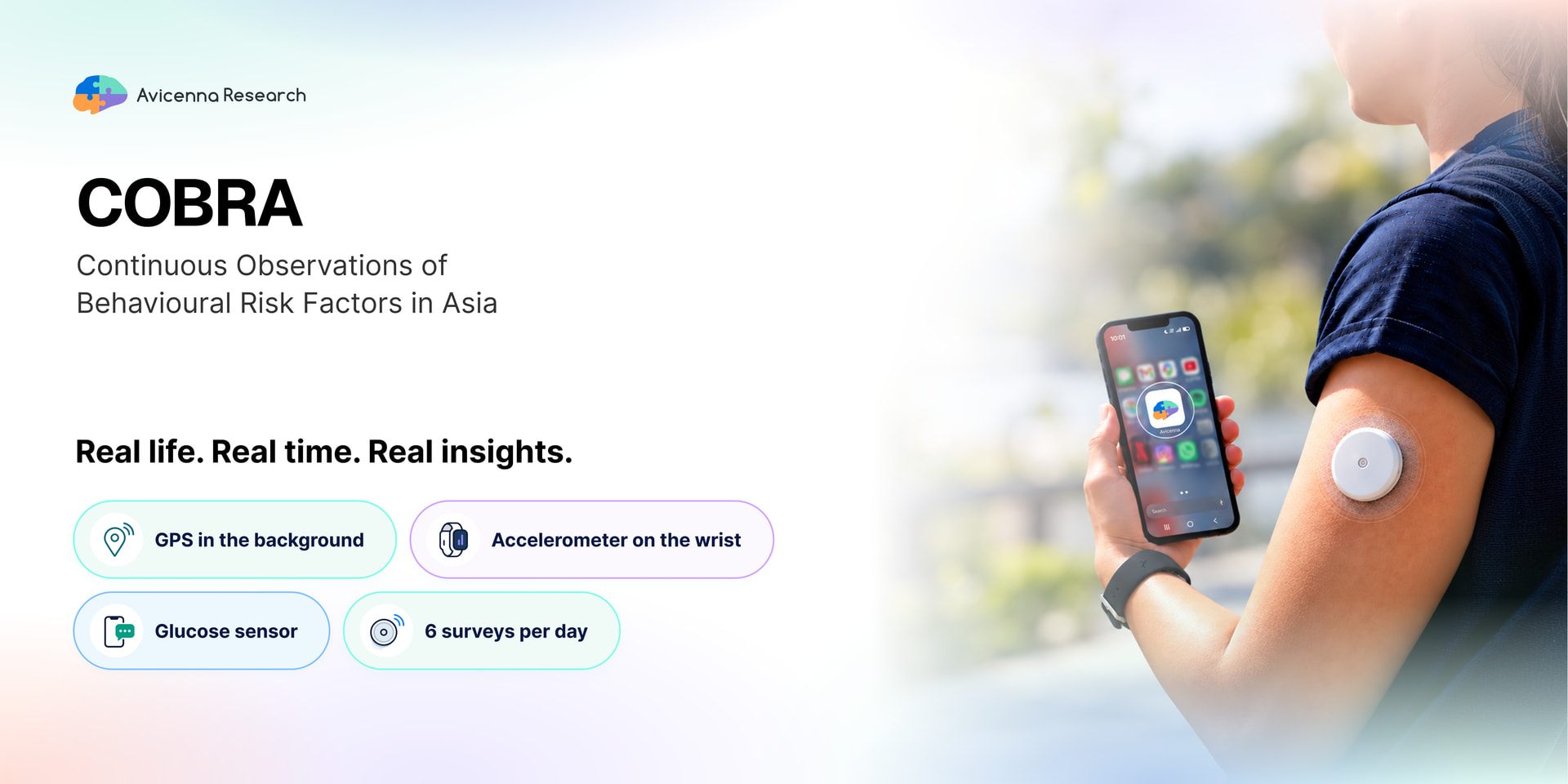
How do everyday behaviors, eating patterns, physical activity, sleep, and other contextual factors relate to physiological responses such as blood glucose? Answering this question requires measuring both at the same time, in everyday life rather than in a clinic or laboratory.
The COBRA study (Continuous Observations of Behavioral Risk Factors in Asia) was designed to do this. Over nine consecutive days, participants continued their normal routines while three types of data were collected in parallel: Avicenna prompted them six times a day to report what they were eating, doing, and feeling; a masked glucose sensor recorded interstitial glucose every 15 minutes; and an accelerometer continuously recorded movement.
COBRA was conducted by researchers at the Saw Swee Hock School of Public Health, National University of Singapore, nested within the Singapore Multi-Ethnic Cohort (MEC), with collaborators in the United States and Germany. Recruitment ran from May 2021 to August 2024.
Continuous sensors show what happened. Participant reports help explain what was happening around it.
Study at a Glance
| Study feature | Detail |
|---|---|
| Population | Adults aged 21–69, of Chinese, Malay, or Indian ethnicity |
| Invited | 2,304 |
| Took part | 1,304 (57% of those invited) |
| Recruitment period | May 2021 to August 2024 |
| Main monitoring | 9 consecutive days |
| EMA | 6 surveys/day, randomized within 6 fixed daily windows |
| Questions | 33 unique questions, delivered with branching logic |
| Glucose | FreeStyle Libre Pro iQ, every 15 minutes, masked from participants |
| Movement | Axivity AX3, worn on the non-dominant wrist and, for some participants, the thigh at 100 Hz |
| Location | Smartphone GPS, collected in the background by Avicenna |
| Follow-up | Optional 9-day EMA and GPS wave, 6 months later |
| EMA response rate | Above 90% in every published analysis to date |
How the Study Worked
Participants attended a baseline visit where they completed questionnaires and physical measurements, had Avicenna installed on their own smartphone, and were fitted with the study devices. Then, they continued their normal activities for nine days.
Six Surveys Across the Day
Avicenna delivered six surveys at random times within predefined windows:
| Survey | Window |
|---|---|
| 1 | 08:00–09:30 |
| 2 | 10:30–12:00 |
| 3 | 13:00–14:30 |
| 4 | 15:30–17:00 |
| 5 | 18:00–19:30 |
| 6 | 20:30–21:30 |
Randomization prevented participants from knowing the exact prompt time while ensuring that different parts of the day were sampled consistently.
Each of the first five surveys could send up to four reminders at ten-minute intervals. The final survey of the day sent up to two.
The EMA instrument contained 33 unique questions covering sleep, general activities, diet, physical activity, screen time, stress, hunger, fatigue, affect, self-efficacy and behavioral intentions, physical environment, and social interactions.
Branching logic meant participants only saw questions relevant to their previous answers, so they did not have to complete the full instrument at every prompt.
Meal Reports
Participants also reported meals and other food or drink intake through Avicenna. The resulting records could capture what they ate or drank, where they ate, who they were with, what they were doing, and how hungry, tired, stressed, or happy they felt beforehand.
To keep the burden low and response rates high, the team deliberately did not collect portion sizes. Participants selected from predefined, Singapore-specific food group lists instead.
These reports provided timestamped behavioral events that could later be examined alongside glucose, movement, and location data.
Continuous Measurements
At the same time, separate devices continuously collected physiological and movement data.
- The FreeStyle Libre Pro iQ measured interstitial glucose every 15 minutes from the upper non-dominant arm. The sensor was masked, so participants could not see their readings during the study.
- The Axivity AX3 recorded movement continuously at 100 Hz on the non-dominant wrist. Participants who agreed also wore a second AX3 taped to the thigh.
- GPS was collected through Avicenna in the background to provide information about participants’ locations.
The devices did not need to be connected to one another during data collection. Their measurements could be aligned afterwards using participant identifiers and timestamps.
Where Avicenna Fits
Avicenna provided the smartphone-based data collection layer of COBRA. It was used to:
- deliver the six daily EMA surveys
- randomize prompts within predefined time windows
- send reminders
- apply branching logic
- collect meal and behavioral reports
- collect GPS in the background
- provide timestamped data for later analysis
This meant Avicenna could capture information that the wearable devices could not directly observe.
For example, a CGM can show that glucose changed after a particular time. Avicenna can provide information about whether the participant had just eaten, what they ate, where they were, what they were doing, and how they felt. Similarly, an accelerometer can measure movement without providing information about why the participant was moving or what they were doing at the time.
One Protocol, Multiple Research Questions
The same nine-day protocol has supported several separate analyses, each using a different combination of valid EMA, meal, glucose, or movement data.
Diet, physical activity, and sleep in relation to postprandial glucose responses under free-living conditions (2024): How do diet, physical activity, and sleep relate to postprandial glucose responses in daily life? The study analyzed 11,333 meals from 789 participants, who responded to 92% of their EMA prompts.
Associations of eating context with dietary quality, satiety, and postprandial blood glucose (2026): How are eating location and other contextual factors associated with dietary quality, satiety, and postprandial blood glucose? The study analyzed 20,629 meals from 1,291 participants, who responded to 63,408 EMA surveys, or 91% of those scheduled.
Postprandial glucose level decreases and appetite in adults without diabetes (2026): Are decreases in postprandial glucose associated with appetite and the timing of the next meal? The study analyzed 895 participants, who responded to 93% of their EMA prompts.
The analytical samples differ between papers because each question required a different combination of valid data. This shows how a single intensive monitoring protocol can support multiple research questions.
Research Team
Rob M. van Dam, Ph.D.
Co-senior author and study lead
Saw Swee Hock School of Public Health, National University of Singapore
Milken Institute School of Public Health, The George Washington University
Falk Müller-Riemenschneider, Ph.D.
Co-senior author and study lead
Saw Swee Hock School of Public Health, National University of Singapore
Berlin Institute of Health, Charité-Universitätsmedizin Berlin
Sarah M. Edney, Ph.D.
First author of the COBRA study protocol
Saw Swee Hock School of Public Health, National University of Singapore
Jiali Yao, M.Sc.
First author of the postprandial glucose and appetite analysis; co-first author of the eating-context analysis
Saw Swee Hock School of Public Health, National University of Singapore
Leah Turton
Co-first author of the eating-context analysis
Milken Institute School of Public Health, The George Washington University
Publications
- Advancing understanding of dietary and movement behaviors in an Asian population through real-time monitoring: Protocol of the Continuous Observations of Behavioural Risk Factors in Asia study (COBRA). Edney, S. M., Park, S. H., Tan, L., et al. (2022). Digital Health, 8.
- Diet, physical activity, and sleep in relation to postprandial glucose responses under free-living conditions: an intensive longitudinal observational study. Yao, J., Brugger, V. K., Edney, S. M., et al. (2024). International Journal of Behavioral Nutrition and Physical Activity, 21, 142.
- Associations of eating context with dietary quality, satiety, and postprandial blood glucose in free-living Singaporean adults during 9 days of intensive digital phenotyping. Turton, L., Yao, J., Rebello, S. A., et al. (2026). International Journal of Behavioral Nutrition and Physical Activity, 23, 43.
- Postprandial Glucose Level Decreases and Appetite in Adults Without Diabetes. Yao, J., Edney, S. M., Tan, L. W. L., et al. (2026). JAMA Network Open, 9(3), e263426.
Planning a Similar Study?
Avicenna supports study protocols like COBRA through features such as Surveys, Triggering Logics, Activity Sessions, Notifications, Data Sources, Background Data Collection, Location, and Participation Periods. Researchers can also use integrations such as Fitbit, Garmin Health SDK, Oura, Hexoskin, HealthKit, Buzud, and phone sensors, depending on the data they need to collect. File-based workflows can also support devices without a direct integration.
You can also use Avicenna for Eligibility Screening, Criteria, Localization, Multi-Site Studies, Branching Logic, and Raw Data. If the wearable or sensor you need is not currently supported, you can discuss your requirements with our technical team.
Explore Avicenna’s features and integrations or talk to our team to see how you can build your study protocol.