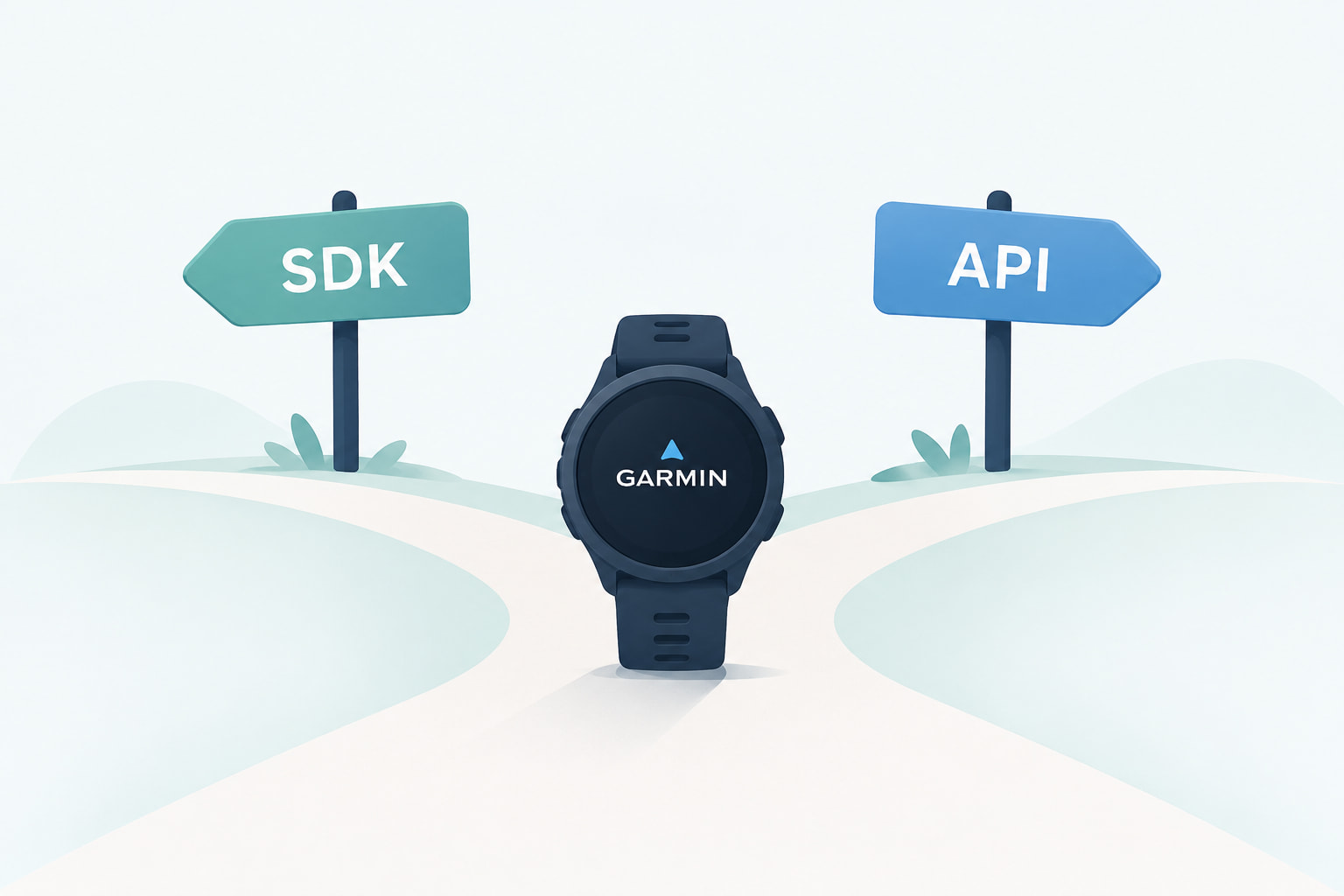
Avicenna integrates with Garmin wearables through two distinct paths: the Garmin Health API and the Garmin Health SDK. Because a device can only pair with one app at a time, your study must stick to one integration path. You cannot mix both within the same setup or swap between them for different participants.
This choice isn’t just a technical backend detail. It affects your data granularity, data pipeline, and participant setup.
What Are the Main Differences?
| Feature | Garmin Health API | Garmin Health SDK |
|---|---|---|
| Data Type | High-level processed metrics, such as Body Battery and VO2 max | Raw/low-level sensor data, such as accelerometer and beat-to-beat data |
| Sampling | Fixed by Garmin Connect standard sync intervals | Configurable for several metrics, with sensor data available at higher fixed frequencies |
| Data Pipeline | Device → Garmin Connect → Garmin servers → Avicenna | Device → Avicenna app → Avicenna or institution server |
| App Requirements | Requires Garmin Connect installed and paired | Requires Garmin Connect uninstalled; pairs directly with Avicenna |
| Watch Features | Preserves supported call/SMS notifications and media controls | Does not provide these Garmin Connect-based features through the Avicenna setup |
What Data Does Each Integration Provide?
What data does your study protocol actually demand?
What Does the Garmin Health SDK Provide?
-
Choose the SDK for lower-level sensor access: If your research focuses on movement dynamics or custom algorithm development, the SDK gives you access to lower-level sensor data. This can include 3-axis accelerometer data (25 Hz), gyroscope data (32 Hz), beat-to-beat intervals (inter-beat intervals/IBI), skin temperature, wrist status, and zero crossing. You can also configure sampling rates for metrics such as heart rate or SpO2 from every 1 second to once an hour.
-
Sampling matters when you need the underlying signal: The sampling rate determines how frequently a measurement is collected. For example, a 25 Hz accelerometer records 25 measurements per second. This can matter when your protocol requires a particular frequency or when you need the underlying signal rather than a processed summary.
What Does the Garmin Health API Provide?
-
Choose the API for processed metrics: If your study relies on Garmin-derived metrics such as Body Battery, VO2 max, Stress, or Fitness Age, the API provides access to Garmin’s calculated data when available for the participant’s device.
-
Garmin-derived metrics are calculated by Garmin: These are higher-level measurements generated from data collected by the device. They are different from raw sensor measurements and may not be reproducible from the SDK data alone.
[!note]
Sensor and metric availability varies by model. Always verify that your target wearable hardware supports the specific data your protocol requires.
Where Does Your Data Travel?
Where your data travels before reaching your database can affect institutional approval and data governance requirements.
API Path:  [Garmin Device] ── Bluetooth ──> [Garmin Connect App] ──> [Garmin Cloud] ──> [Avicenna]
SDK Path:  [Garmin Device] ── Bluetooth ──> [Avicenna App] ─────────> [Your/Avicenna Server]
-
The API route: Data travels from the watch through the participant’s Garmin Connect app and Garmin’s servers before Avicenna retrieves the available data. If your institution has requirements concerning third-party cloud processing or storage, this data path is an important consideration.
-
The SDK route: The watch connects directly to the Avicenna app over Bluetooth, which then sends the collected data to the configured server, including an institution’s own Avicenna infrastructure where applicable.
What Does the Participant Need to Do?
How you collect data can influence participant compliance and daily wear habits.
-
API setup: Participants keep using their watches with Garmin Connect. They can continue using supported watch features such as call/SMS notifications and media controls. This can be useful when participants are using their own devices and the study aims to minimize changes to their normal routine.
-
SDK setup: Participants must uninstall Garmin Connect so the watch can pair with the Avicenna app. The watch is then connected directly to the Avicenna app rather than Garmin Connect, so Garmin Connect-based smartphone features such as notifications and media controls are not available through this setup.
How Do You Choose?
Ask your team three core questions before enrolling your first participant:
-
Do you need lower-level sensor data or Garmin-derived metrics? If you need beat-to-beat intervals or high-frequency accelerometer data, check the SDK data available for your target device. If you need Body Battery or VO2 max, check the API data available for that device.
-
Where must data travel? If your study has specific requirements concerning third-party cloud processing or storage, compare the API and SDK data paths with those requirements.
-
How will participants use the watch? If participants are using their personal wearables and need supported Garmin Connect features such as smart notifications, consider the API setup. If the study requires direct communication between the watch and Avicenna app, consider the SDK setup.
[!note]
For more details about the data available, setup requirements, and supported devices, see our Garmin Health API and Garmin Health SDK documentation.
Need help evaluating your protocol? Reach out to the Avicenna team at sales@avicennaresearch.com.